
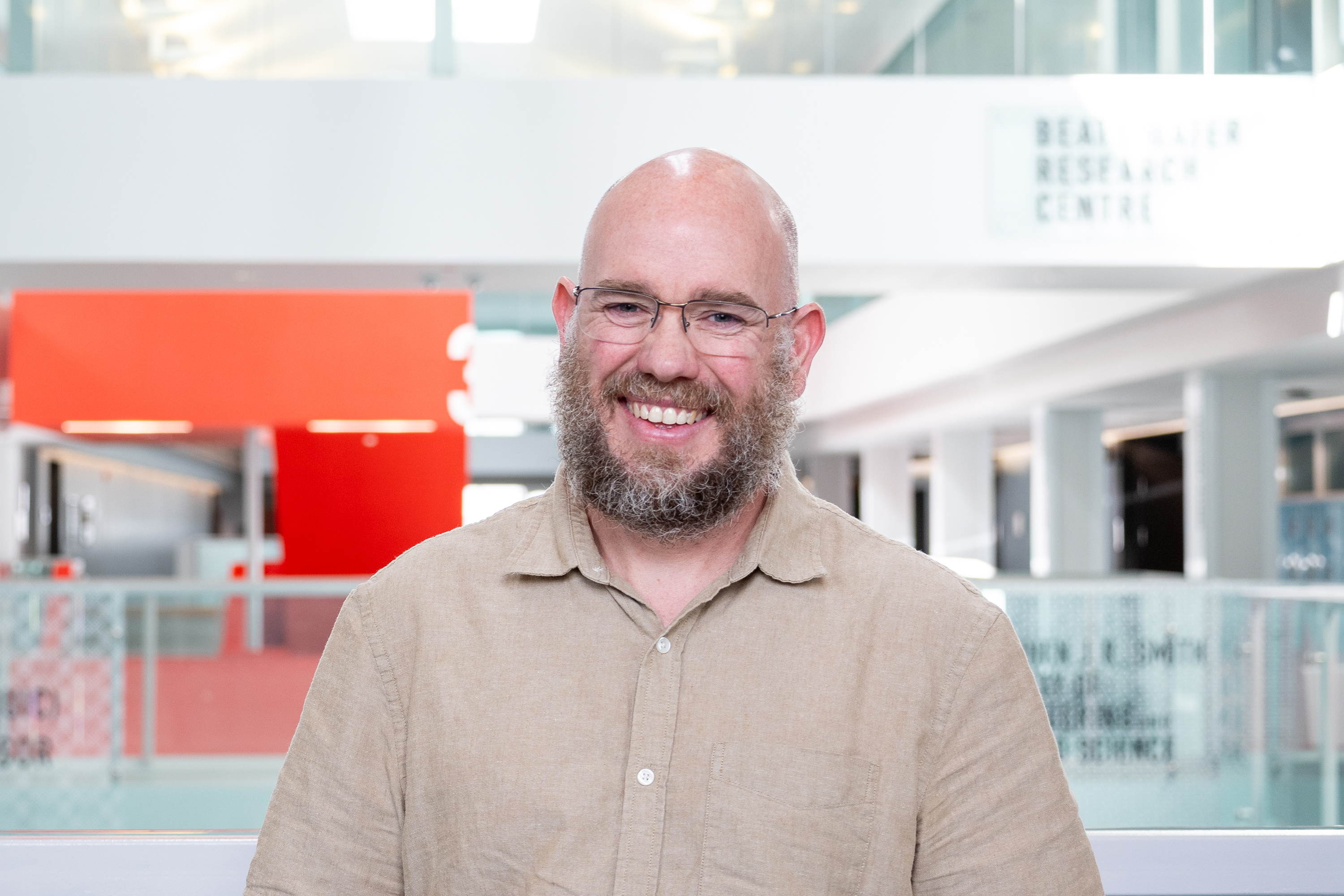
On July 1, 2026, Dr. Michael Rainbow began a five-year term as Head of the Department of Mechanical and Materials Engineering (MME).
Michael Rainbow received his PhD in Biomedical Engineering at Brown University in 2012. He then completed a postdoctoral role at Spaulding Rehabilitation Hospital – Harvard Medical School. He is an Associate Professor in MME and The Centre for Health Innovation at Queen’s University. Dr. Rainbow’s research focuses on understanding the relationships between form, function, and dysfunction in multi-articular joint structures of the appendicular skeleton. He leads the Skeletal Observation Laboratory, where he and his team use a comparative approach to analyze musculoskeletal function using modalities such as optical motion capture, biplanar x-ray, CT, MRI, and Ultrasound. His group frequently collaborates with researchers in biological anthropology, orthopedics, rehabilitation, computer science, exercise science, and motor control.
Get to know Smith Engineering’s newest department head with this Q&A.
Tell us a little bit about yourself. What do you like to do when you’re not working?
I have been at Queen’s for more than a decade, and I have come to feel very at home in the Department of Mechanical and Materials Engineering. Outside of work, I enjoy spending time with my wife and son, our Australian shepherd, and our cat; reading, especially imaginative fiction and non-fiction; drawing; lifting weights; yoga; and getting outside. My son and I also play Dungeons & Dragons together, which is always a great time!
I am drawn to books, films, and games with a sense of atmosphere. I have a soft spot for moments of wonder and awe, and I have learned to go looking for them in ordinary days.
What is the one thing (or more) that you want students and alumni to know about you?
I see students and alumni as whole people, not just transcripts or job titles. Engineering can be demanding, and it is easy to feel as though you are supposed to have everything figured out. No one does, and I would not want it any other way. I care about how students are doing, not only how they are performing, and my door is open.
To our alumni, you remain part of this community long after you graduate, and I would love to hear where your paths have taken you.
I also love ideas and enjoy working with people in ways that help us put our best thinking forward together, across different roles and perspectives. I believe people do their best work when they feel challenged, supported, and seen. I value curiosity, generosity, humility, and the willingness to keep learning, especially when something does not go as planned. I hope people find me approachable, thoughtful, and genuinely interested in what they are trying to build.
What are you most proud of in your career so far?
The people. Watching students arrive unsure of themselves and leave as confident, capable engineers and researchers, not to mention wonderful human beings, is the most meaningful part of this work.
What is the focus of your research / area of expertise?
My research is in the biomechanics of human movement. I study how bones, joints, muscles, and tendons work together during movement, particularly in the foot, knee, shoulder, and wrist.
A central part of my work uses high-speed, dual-plane X-ray imaging to measure how bones move inside the body during real activities. Combined with motion capture, medical imaging, and computer modelling, this lets us ask questions that are difficult to answer any other way: How does joint shape influence movement? Why do some people develop pain or injury while others do not? And how can we design better interventions, from orthotics and rehabilitation to surgical approaches, to help people move well throughout their lives?