
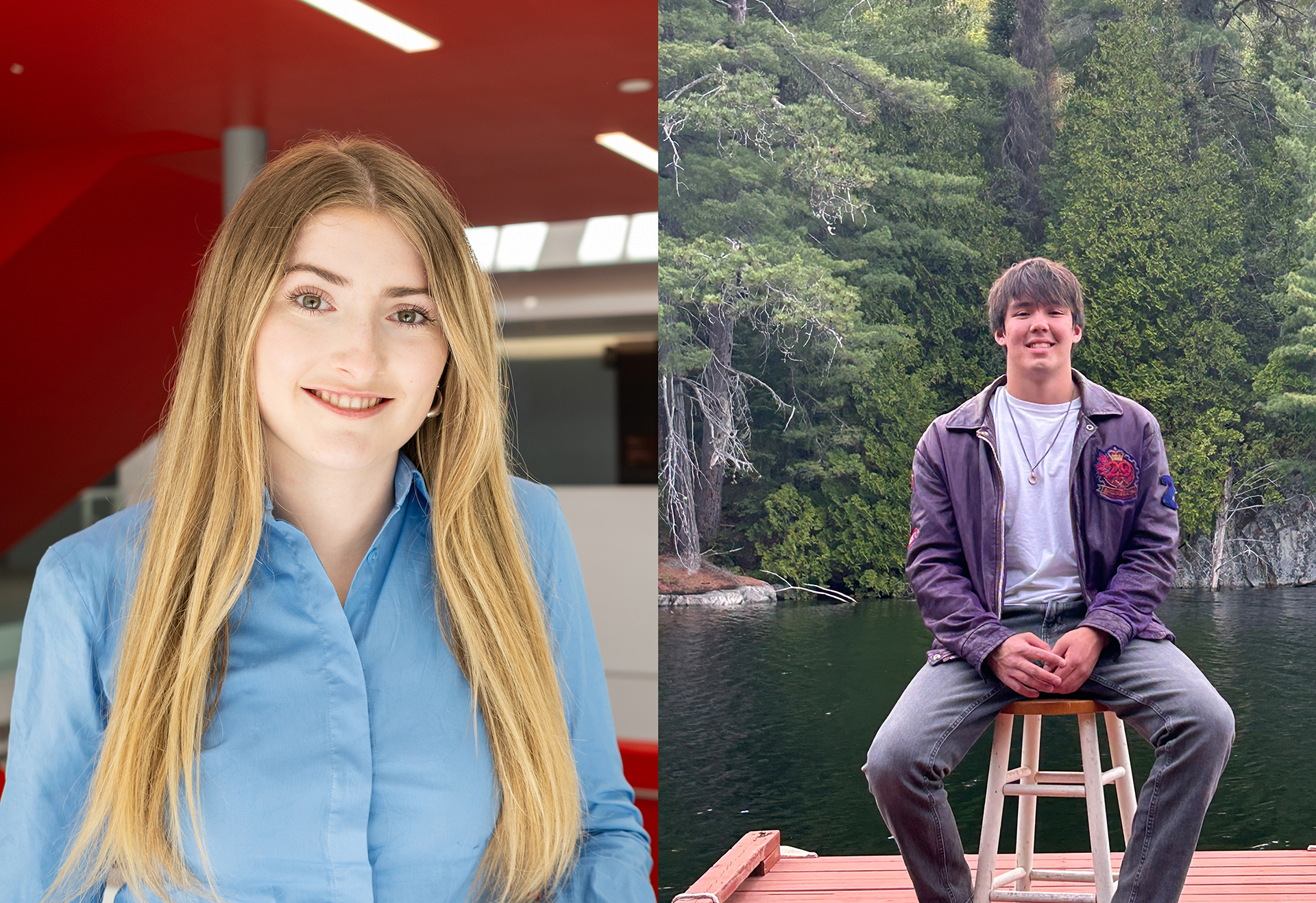
Emma Godbout is finishing her third year — her first in engineering, having transferred after two years as a physics major with an Astrophysics specialization in the Department of Physics, Engineering Physics, and Astronomy. She decided to make the switch because of her experiences on the all-Indigenous High-Powered Rocketry Design Team, a multi-award-winning student design team that has been competing since 2020. "Being on the rocket team and seeing fellow students like Madelaine (Duncan) and Justice (Bressette-Fleming) as engineering students and rocket team leads inspired me," she says.
"I was on the aerodynamic modelling subteam for my first and second year, while I was in astrophysics, and we went to the First Nations Launch competition in Kenosha, Wisconsin. Those two years were an amazing opportunity to make great connections and see industry professionals talk about their experiences and judge our designs with constructive feedback."
Now in Engineering Physics with a specialisation in Mechanical Engineering, Godbout is still on the rocket team. The competition has changed, so she has partnered with Bressette-Fleming on a focused, Ottawa-based competition, building a rocket that protects an egg in flight, with a stretch goal to add sound generation to make it easier to locate returning rockets.
Her experience in astrophysics gave her a strong grounding in physics — including a summer research project that allowed her to work with Drs. Kristine Spekkens and Nathan Deg. As a recipient of a Natural Sciences and Engineering Research Council of Canada (NSERC) Undergraduate Student Research Award (USRA), Spekkens and Deg supervised Godbout on a project where she found over 500 galaxy clusters in the WALLABY survey, using data from the Australian Square Kilometre Array Pathfinder (ASKAP) radio telescope in Western Australia and Python scripts of her own design. "It was a fantastic opportunity. Ultimately, I learned that academia might not be the right fit for me, and engineering felt like the place to go," she says.
Transitioning from astrophysics to engineering has led to a complicated first year as an engineering student, taking a mix of first-, second-, third- and fourth-year courses, including a special course for transfer students, APSC 202. "All of my physics courses transferred over, so this past year has been hands-on with engineering, and I've really been enjoying it — I'm really happy I transferred," she says.
Nixon Ball has known that engineering was right for him since high school when he started planning for the future. "I've been considering teaching, and of all the undergraduate degree options, engineering was the most interesting. I like to understand how things work, how we can improve on things, and throughout high school, robotics was my thing. I would pour hours into it. So, when I saw that there was a mechatronics program at Queen's, I looked into it, and my friends and family agreed it would be a great fit for me."
Coming into Mechatronics and Robotics Engineering as a direct-entry student, Ball spent part of the year "just trying to figure out how to survive engineering," he laughs. "It took some time to get used to, and balance all the things I have going on, but I'm really happy with how the year went." In the mix of theoretical and practical, it was the hands-on courses that appealed to Ball's robotics interests the most: "I like the design programs, being given a task and how to approach it, then seeing actual solutions from real engineers and how they did it. There are obstacles you have to face, and it was frustrating at times, but it really teaches you how to think like an engineer."
Godbout is from Kenora and her home community is Couchiching First Nation, near Fort Frances, in Northwestern Ontario. Ball hails from Bear Island, on Lake Temagami. Both students have found the campus very welcoming for Indigenous students. "Even before switching to engineering, STEMInA (STEM Indigenous Academics) was where I met most of my closest friends," Godbout says. "There's a transition week, before everyone moves into residence, where Indigenous students in STEM can come for a week of planned activities. The people I met that week are still all my friends."
Ball quickly found support through the faculty program Indigenous Futures in Engineering, as well as an on-campus community: "Four Directions, the Indigenous Student Centre, is a place I felt really at home, meeting a lot of like-minded people and talking to them about their backgrounds and what home is for them."
Both also have an interest in paying it forward by sharing their knowledge. For Godbout, she had the opportunity to be featured at Queen's recent Women+ in Physics Canada (WIPC+), where she delivered a presentation about the rocket team. "They reached out and asked if I'd be a speaker; it turned out to be amazing. I gave a 10-minute talk on our rockets from the two past years, our successes, what we learned. I had really positive feedback, and it was a great opportunity to show how Indigenous students can get involved in hands-on engineering."
For Ball, he's still considering teaching as a future goal. "In high school, I had the opportunity to mentor younger students and help them with their robots when I was in grade 11 and 12," he says. "I found that experience to be really rewarding. I may still decide to become a professional engineer, but I think teaching computer science, or physics, at a school with a robotics program is something I'd enjoy a lot."