
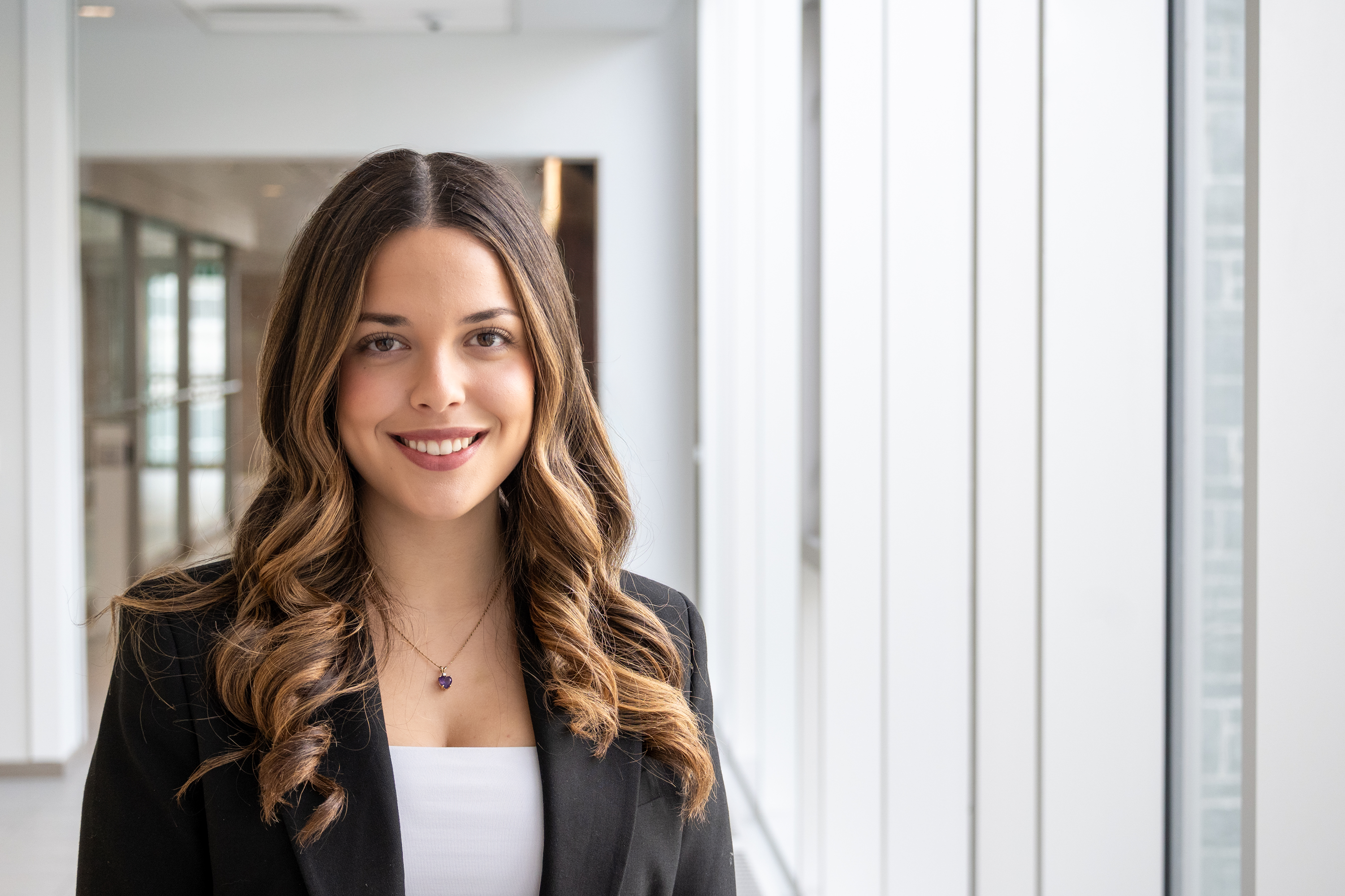
It was a medical journey that started with a shocking diagnosis and ultimately reshaped an engineering student's outlook on life and her future career. Sidonia Tameshtit, an Applied Mathematics and Mechanical Engineering undergraduate student, is the recipient of the Brain Tumour Foundation of Canada Brain Tumour Research Studentship generously funded in honour of Anand Acharya. It's an award that means a lot to her; not only as a developing researcher, but as a brain tumour survivor herself.
"The award supports a late-stage undergrad student or an early-stage medical school student pursuing research in brain tumour treatment, specifically with a preference to glioblastoma treatment, which is one of the hardest brain tumours to treat," Tameshtit explains. In her case, the Foundation will be supporting her for two summers of research work, under the supervision of Dr. Xian Wang, a Mechanical and Materials Engineering professor.
Her work will stem from Wang's research expertise in medical robotics for tumour treatment: a subject directly relevant to Tameshtit's own experience. After suffering from migraines for years, "in January 2025, I was at a conference on campus and had a grand mal seizure," she says. "I was at Kingston General Hospital at two in the morning when a doctor came in to tell me I had a brain tumour."
The tumour, on Tameshtit's left occipital lobe, had been missed in earlier scans but had grown since. "It was like that initial seizure broke the dam," she says. "I was having seizures every other day; I was not in a good physical or mental state." The ultimate prognosis was a grade-one benign meningioma and thankfully was treatable. "I had the lucky tumour," she reflects. "Despite it being the most difficult thing I have ever faced, I never want to take for granted that I had treatment options, while so many others diagnosed with brain tumours are told theirs are inoperable."
Despite the challenges she faced, Tameshtit persisted in her studies—cutting back to two classes that term—and travelled during the break between her exams and surgery ("You're 20, you have a brain tumour, you learn to appreciate things from a different perspective," she says). Post-surgery recovery meant contending with vision issues, physical fatigue, and short-term memory challenges, all of which are now greatly improved. She had been scheduled to start the Queen's University Internship Program (QUIP) in May of that year, but with an accommodating employer and support from Queen's, moved her internship start date later into the summer.
It was during her QUIP internship that she stumbled across a story on the Queen's website about Dr. Xian Wang's work. "I wasn't even at the school, and suddenly, here's an article on a mechanical engineering professor doing glioblastoma research." The connection seemed like fate: For Tameshtit, finding a professor doing research related to her condition, in the same faculty was serendipitous. "I sent him an email, and he invited me to come in, sit in on meetings and see the graduate students’ presentations," she said. "I was entranced, and obviously deeply invested on another level."
It was Wang who encouraged Tameshtit to apply to the Brain Tumour Foundation for funding and invited her to work in his lab as a researcher. "His lab has worked on magnetic nanoparticles and guiding them externally with magnetic fields," Tameshtit explains. "The problem with glioblastomas is that they're so difficult to treat because they're highly invasive. They're inoperable, typically; deeply embedded in the brain. They're very fast-growing, and they don't respond well to drugs because the blood-brain barrier is extremely efficient at filtering out any targeted therapies."
The Brain Tumour Foundation of Canada is funding two summers of research for Tameshtit, her work branching off the main focus of Wang's research team. She will be concentrating specifically on how to create a bio-hybrid drug delivery system using magnetic nanoparticles linked to macrophages to deliver medication via external magnetic field manipulation. "The first summer will be experimenting with electromagnetic closed-loop control of a micro-bead," she says, "and the second summer will explore drug loading the magnetic bio-hybrid system to be guided within the brain’s ventricles."
Her medical experience was transformative; the opportunity to pursue research in Wang's lab has also resulted in a sea change for Tameshtit's approach to engineering and her future career. "I had been considering different career paths, different industries, but hadn't really found one that had stuck yet," she says. "I hadn't really thought about research as a career. But now that this door has opened, and I'm aware of what's behind it, I'm really excited. There's so much to be done, and as an applied mathematics and engineering student doing biomechanical research, I feel like I have a unique perspective to bring to the table, on top of my experience as a brain tumour patient."
Tameshtit is grateful to be welcomed to Wang's lab, for the support of the Brain Tumour Foundation of Canada and their donors, and equally grateful for the support of her family, friends, and the Smith Engineering and Queen's community. "I had such a great experience with my professors, the staff, and everyone who worked to put me on a path where I could graduate with my friends," she says. "It really showed me and my family what compassion you can find behind the big block letters of a school's name."