
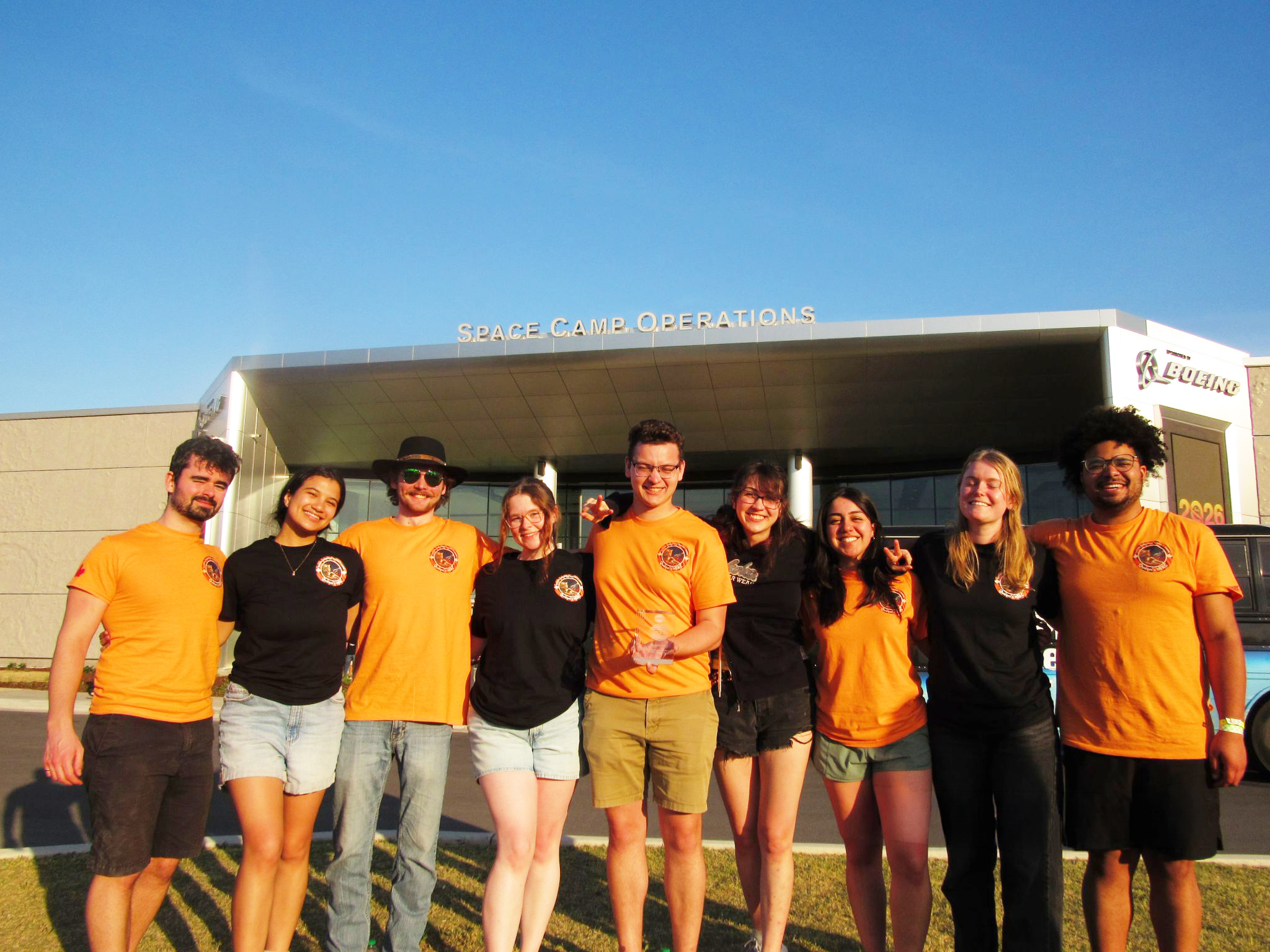
NASA-recognized ingenuity. It's not something many can boast, but for Brandon Lewis, William Hollett and the rest of the Human Exploration Rover Challenge (HERC) design team at Smith Engineering, it is now a reality. Now finishing their fourth year in Mechanical Engineering, Lewis, the project's Chief Technical Officer, and Hollett, the Chassis Lead, joined teammates at the U.S. Space and Rocket Center in Huntsville, Alabama to compete in the NASA Human Exploration Rover Challenge in April. The trip did not disappoint, as they brought home the Ingenuity Award. "We had quite a bit of national pride to go down there as the only team representing Canada," Lewis says.
Participating student teams have nine months to design and build remote-controlled or human-enabled rovers that can accomplish mission tasks while crossing lunar terrain. The Smith Engineering team is only two years old, and has won the Ingenuity Award both years; per NASA, "the Ingenuity Award is presented to the team that has impressed NASA with exceptional creativity, problem solving, and original thinking, regardless of division; for the boldest idea that addressed a problem with audacity and creativity."
"You have to tackle a problem in a different way than other teams do," Lewis explains. "It means coming up with a lot of different designs, seeing how things are currently done. One of the initial observations was that NASA rovers have deployables (features that are stowed during space travel, but unfurl for use upon landing), we wondered 'how can we replicate that, but on a remote-control scale?' We pitched the idea of having a remote-controlled rover be a capstone project for fourth-year mechanical engineering students, and that's when William and some others came on board."
As ideas developed, one was favoured — Lewis' vision of having not one, but multiple rovers. "Brandon said 'we're making three rovers,' and I was thinking 'from an engineering standpoint, that's probably not the best use of resources,'" Hollett laughs. "We got some pushback from our capstone supervisor, but Brandon persevered."
The final product was three small rovers, dubbed Eenie (Environmental Extractor for Near-Surface In-situ Evaporation), Meenie (Mobile Environmental Evaluator for Neutrality and Ionic Equilibria) and Moe. "Moe was the 'Mothership Of Excursions,' which housed Eenie and Meenie," Lewis says. "Eenie and Meenie would go off and Eenie would collect soil, and Meenie would collect water, test for pH and moisture content. Moe would handle all the obstacles and terrain challenges." The three robots were run by two operators, with one person running Eenie and Meenie, and another controlling Moe. "The approach was partly a proof of concept, to see if we could do something in a lighter way than the other teams," Lewis says. "The other push for multiple rovers was the fact that you only have 12 minutes on the obstacle course, a 'timed oxygen supply,' to do as many of the obstacles as time allows. We could go to a task site while driving through, drop off one of the rovers, and while it was doing its task, continue on — parallelize the tasks to make the most of the time we had."
One of the highlights of the trip for Lewis was having a NASA official recognize the group's work by name. "We were at a safety briefing and mentioned we were the team with multiple rovers, and a NASA bigwig said 'oh yeah, Eenie and Meenie, right?' That might be the highlight of my engineering career — to have a NASA official remember our work."
All of this was, of course, a team effort. Lewis and Hollett were joined by Seth Niescier, Kalle Stewart, and Amanda Donoso through the year and on the trip to Huntsville.
Above and beyond honing their hands-on engineering skills, the team also benefited from the practical experience of building a project from start to finish. "There were a lot of things we learned along the way," Hollett says. "Our professor introduced the concept of quality function deployment, QFD, a process that relates technical engineering requirements to customer requirements and weighs them against each other. It was really helpful when we were designing individual components and thinking through questions like how to evaluate a chassis design when balancing competing needs like a lightweight and stiffness. It's something I can see myself using in the future."
For Lewis, the project reinforced how crucial it is to have skills beyond strict engineering aptitude. "One thing I've carried with me this year is the importance of collaboration and communication within the team," he says. "In terms of how projects run, collaboration is really the underpinning of success."
Both appreciate the support of their sponsors at NordSpace, the overall support of Smith Engineering, and especially the strong design team culture at the faculty. "I can't emphasize the importance of design teams enough," Lewis says. "I've learned as much in the past two years from this team as I have in four to five years of classwork. It's a fantastic opportunity for students to get involved and gain technical knowledge, learn how to collaborate better in groups, and have a project you're excited about that you can see through while preventing future mistakes by learning in a safe environment."