
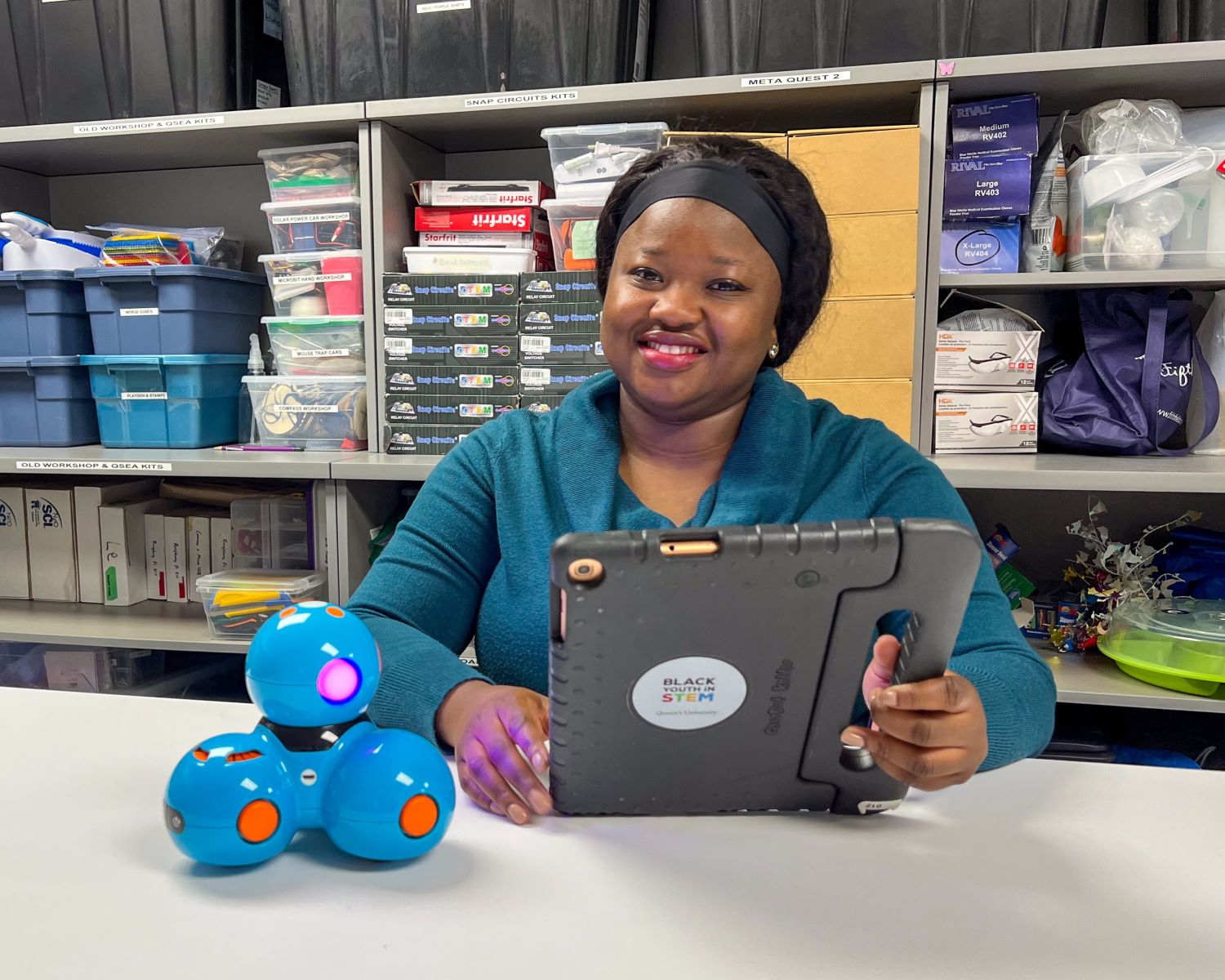
As a national initiative, the Indigenous and Black Engineering and Technology (IBET) PhD Project has been a cornerstone in opening doors for talented Indigenous and Black students from coast to coast. An initiative shared by the nation’s leading engineering faculties, IBET provides doctoral candidates a mentorship program and funding throughout the course of their studies.
For Yvonne Anabaranze, a student of Mechanical and Materials Engineering, being part of the Indigenous and Black Engineering and Technology project is more than a scholarship. It marks a milestone in a career that was founded on mentorship, and one where mentoring others is increasingly important.
Anabaranze’s path to engineering, to Canada, and to her PhD studies started in her youth at her family’s business. “My parents are small business owners back in Nigeria,” she says, “selling electrical materials, I got curious about light outlets. I knew from cooking that plastic melts in contact with very hot metal, so how could outlets combine metal and plastic together without the plastic melting?” That curiosity led Anabaranze to study the sciences in high school, where her first mentors were teachers who fanned the flames of her curiosity.
She developed an interest in a career in manufacturing, “to know how these electrical materials were created,” which led her to Nigeria’s Federal University of Technology Akure (FUTA) and an undergraduate degree in metallurgical and materials engineering.
From there she pursued her Master of Engineering in Canada, after a friend recommended Queen’s. Anabaranze pursued a project-based M.Eng. working with faculty including Professor Bradley Diak. Following her Master’s and a stint working in engineering in the manufacturing industry, Anabaranze was invited by Diak to work under him on her PhD studies. “Having somebody recruit me to work with them felt great. It even feels great today,” she says.
It was during her PhD studies that Anabaranze began to reflect the mentorship she’d received throughout her career and personal life. Working with Black Youth in STEM, a Smith Engineering youth education initiative focusing on Black youth in the Kingston region and beyond, Anabaranze has spent years connecting with kids and fostering their own curiosities.
“Around May in 2022, it was at the end of the winter term, I was looking for a summer job and stumbled upon the ad for Black Youth in STEM in CareerQ, a career service at Queen’s,” she says. “I already knew I enjoyed working with children. Kids give me a different perspective: just being around them helps me improve my science communication skills and look at things from a different angle.”
This work gives her an opportunity to be the kind of person that nurtured her interest in science. “I understand the importance of mentorship,” she says. As a woman in engineering, Anabaranze is sensitive to the fact that women are underrepresented in the profession. “In my undergraduate program, we were eight women out of 112 students,” she says. “There are not a lot of ladies in engineering, and in Canada, especially not many Black women. Knowing this, I feel a sense of purpose. I have a very strong affinity to women interested in engineering, and as a Black woman in engineering here in Canada I’m also aware of the challenges that exist for Black youth here that I didn’t experience coming from a predominantly Black country.”
Anabaranze’s work for Black Youth in STEM includes developing programs such as one focusing on forensic science. “When we talk about STEM, there are many fields that tie back to science and engineering as their backbone. The forensic science program came out of me watching Bones, the TV series similar to the CSI series, and thinking about how people go through these processes, from fingerprint analysis to all sorts of areas of science. Because of TV shows like Bones and the CSI series, lots of people are curious about that field, and it can encourage people to think about other STEM fields outside of medicine and engineering that are also good and lucrative, so I made a forensic science program for grades 1 through 12.”
As she continues to work with Black Youth in STEM alongside her PhD studies, Anabaranze sees reflections of her younger self in the students she teaches. “A female student leader at one of the summer programs Black Youth in STEM collaborated on in Toronto approached me, and said, ‘I’m grateful you’re here, talking about forensic science. I was interested in forensic science, but I didn’t know where to go, who to talk to, or if it is even offered in Canada. Knowing that some schools in Canada offer forensic science, I know what’s in the cards for me if I choose to pursue a career in forensic science, and I can reach out to you.’”
As the IBET program’s latest fellowship recipient, Anabaranze is looking forward to continuing her work with Professor Diak — one of many mentors in her career — and reflecting that spirit of mentorship to Black youth.
“Helping these children makes me very happy. When I was growing up with questions about science, I didn’t have anyone who I could ask for help at any time, who could answer these questions. I love seeing the faces of kids when you can show them something and they realize that science is really cool, and I can say to them ‘yes, it is cool, and you need to keep exploring STEM.’”